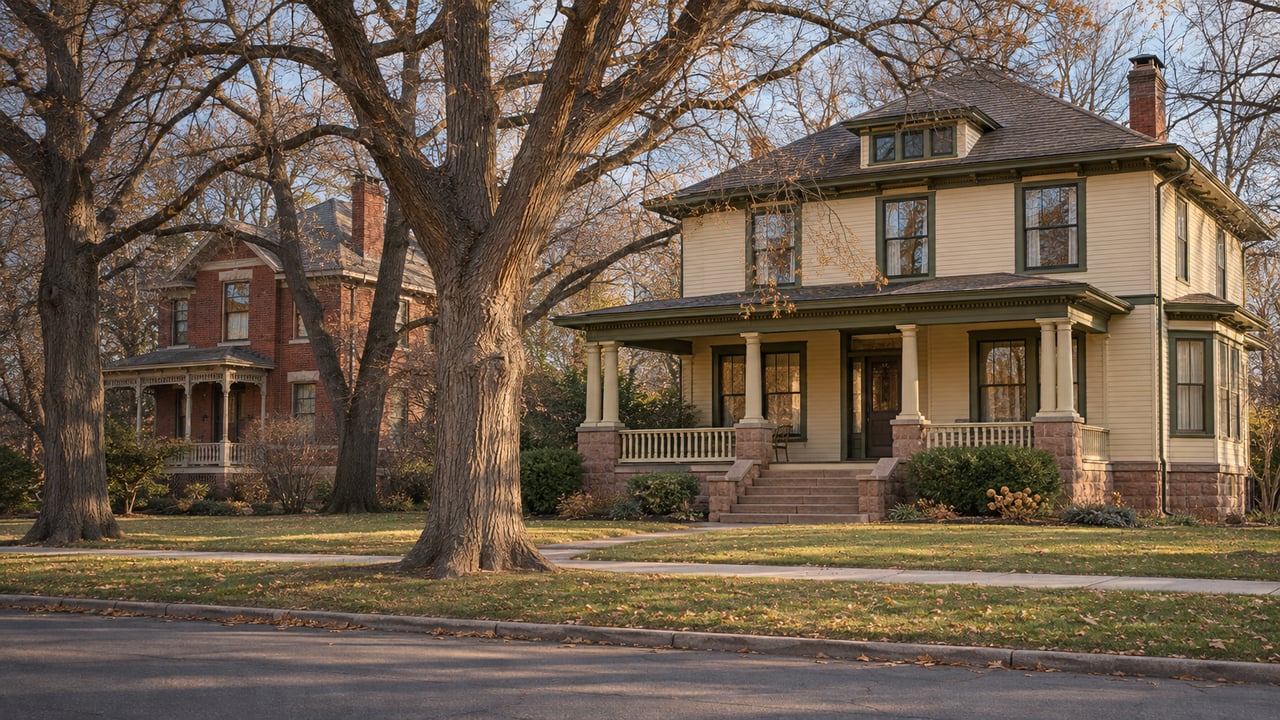
In the summer of 1901, Vice President Theodore Roosevelt came back from a train ride to Cripple Creek and held a political meeting in Philip B. Stewart's living room at 1228 North Wood Avenue. Stewart was a former Speaker of the Colorado House. His neighbors on the 1200 and 1300 blocks of Wood included Cripple Creek gold money, and the stretch became known as Millionaires' Row. Stewart later gave the house to Colorado College, which named it Stewart House.
Those Wood Avenue blocks show a principle that holds across the whole neighborhood. Two homes of similar age, size and price can sit on avenues that were laid out identically and now work as very different streets. General Palmer gave the Old North End one street plan. A trolley line, a college building, a City Beautiful planting program and a 2018 restriping each changed one avenue at a time. The last of those decisions, on North Nevada Avenue, has not been made yet. For anyone comparing Old North End listings, the avenue belongs on the comparison sheet next to the square footage.
Four Avenues From One Plan
The National Register nomination for the Old North End Historic District records that the north-south avenues were platted 140 feet wide. In the early 1900s the city built raised medians 35 feet wide down the center of those avenues. Inside the district, Cascade Avenue, Nevada Avenue and part of Wood Avenue received medians. Tejon Street was just as wide but got no median, because a trolley ran up its center at the time.
The plantings also differed from avenue to avenue. Nevada's medians got two formal rows of deciduous trees. Wood and Cascade got deciduous trees alternating with evergreens, shrubbery and flower beds, plus the crabapples, lilacs and redbuds that bloom along them in spring. The Old North End Neighborhood's history credits Palmer with the wide streets and the City Beautiful movement with the raised, planted medians.
The houses settled differently along those streets too. Homes facing the north-south avenues usually sit back about 25 feet, while homes on the east-west streets often sit 5 to 10 feet from the sidewalk. Garages and carriage houses are mostly reached from rear alleys, so curb cuts are few and narrow. On parts of Wood and Cascade, what looks like a second sidewalk between the walk and the curb is a concrete slab over old irrigation ditches from the El Paso Canal system, which was built in 1872 and used until 1956.
Wood Avenue Has No Route to Downtown
Wood Avenue begins at Uintah Street. Palmer gave Colorado College all the land west of Cascade Avenue down to Monument Creek, so Wood was never connected to downtown, and the neighborhood history credits that with keeping its car traffic down. Only two blocks of Wood, from Uintah to Columbia Street, carry a landscaped median, along with ornate cast-iron Victorian street lights. Those are the Millionaires' Row blocks.
Along with the Stewart house, the neighborhood history lists Alice Bemis Taylor's home at 1238 North Wood. She was the philanthropist whose gift helped build the Fine Arts Center on Dale Street. Gold-mine owner James Ferguson Burns built a rambling mansion over several lots at 1315 Wood Avenue. The Register nomination places most of the district's Estates and Mansions on Wood and Cascade in the southern part of the neighborhood. These are homes on lots of a quarter acre up to an acre and a half, usually 5,000 to 10,000 square feet, and they make up roughly 10 percent of the district's homes. Many have several outbuildings, and some large carriage houses have since been converted to separate residences with their own addresses.
Monument Valley Park forms the wooded western edge of the neighborhood, and Wood is the avenue closest to it. We covered how much of that park access ran through a single crossing in our post on the Old North End bridge closure.
Tejon Street Was the Trolley Street
Tejon had the streetcars and no median, so it might have been expected to become the busy street. A trolley company once proposed running tracks straight through the Colorado College campus. College President William Slocum and Palmer opposed it, City Council sided with them, and the cars were routed around the campus by way of Nevada Avenue and Uintah Street before heading back up Tejon. The college then built Palmer Hall where Tejon would have crossed the campus. With Tejon also closed at its north end, it became one of the quieter north-south streets in the Old North End, because drivers could not use it to get downtown.
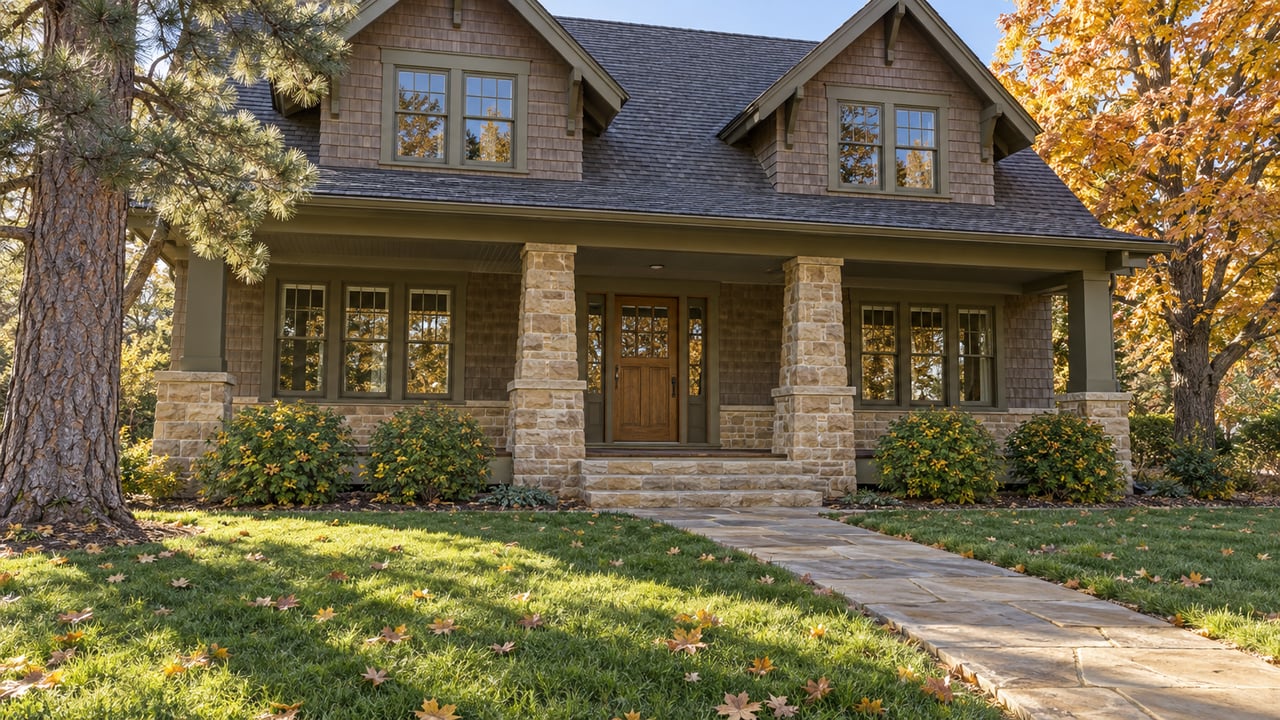
Tejon's typical house is a different product from Wood's. The Register nomination places many of the district's Grand Homes on Tejon and Nevada. These usually sit on 9,000-square-foot lots, run 2,000 to 6,000 square feet, and account for about half of the district. Our architecture guide covers the styles. What matters for this comparison is that a Grand Home on Tejon and a Grand Home on Nevada can match on paper while fronting streets that carry very different traffic.
Cascade Avenue Was Narrowed in 2018
In 2018 the city reduced a segment of Cascade Avenue to one lane in each direction and added bike lanes, following a 2013 study of streets around Colorado College. City traffic engineer Todd Frisbie told The Colorado Sun in December 2025 that crashes fell 40 to 50 percent after the change, overall speeds came down, and no notable congestion resulted.
The southern blocks of Cascade also carry a pattern from the postwar housing shortage. Several larger historic homes on Cascade and Nevada were converted to multifamily housing at that time, many are now rented to Colorado College students, and most still look like single-family homes from the sidewalk. To the north, Penrose Hospital occupies the four blocks bounded by Madison Street, Cascade Avenue, Jackson Street and Nevada Avenue. A home on Cascade can sit beside a college rental, a hospital campus or a run of single-family houses depending on the block, so the same avenue name covers several kinds of address.
Nevada Avenue's Decision Is Still Open
North Nevada Avenue still has the shape it had before Cascade changed. The Colorado Sun described its residential stretch through the neighborhood as about a mile of straight road with two lanes in each direction, and city engineers say it is busier than Cascade. The Old North End Street Safety Committee, a group of about a dozen residents working under the neighborhood association, has pushed for more than a decade for the same one-lane-each-way treatment Cascade received. A 2023 engineering summary prepared for the city by Olsson listed that lane reduction as part of a long-term action plan. Councilmember Nancy Henjum, whose district includes the Old North End, told the Sun she supports the reduction. Frisbie said Nevada "would be a candidate" based on volume, and Public Works director Richard Mulledy said volume alone does not decide it.
The city has not decided either way. In March, The Gazette's editorial board wrote that the city's Safety Action Plan includes a single-lane section of North Nevada "at some point." It also cited a city traffic engineer who told the paper's news staff that "there are a lot of factors to make implementation a challenge." The board itself opposes the change. In June, the city listed North Nevada between East Jackson Street and Fontanero Street, and Wahsatch Avenue between Columbia and Caramillo streets, among the locations for its temporary Safe Streets COS speed feedback sign demonstrations. The city said the demonstrations would stay up at least six months, with successful ones considered for permanent installation. North of the neighborhood, the city's North Nevada corridor program, which runs from Fillmore Street to Garden of the Gods and Austin Bluffs, was still in preliminary engineering in its second-quarter 2026 report to the Pikes Peak Rural Transportation Authority.
For a buyer, this makes Nevada the one Old North End avenue where the street itself could still change. The house can be inspected and appraised. Whether the street out front stays four lanes depends on a city decision that has no date. Nevada also has the neighborhood's most formal median, with the double row of shade trees, and Grand Homes on lots comparable to Tejon's. A buyer weighing a Nevada address against a similar one on Tejon or Cascade is comparing two streets as well as two houses.
North of Fontanero, the Scale Changes
The district does not end with the big avenues. According to the Register nomination, most of the Old North End's Cottages and Bungalows sit north of Fontanero Street. They are typically 1,000 to 2,500 square feet on lots up to 9,000 square feet and make up about 30 percent of the district's houses. Postwar ranches and minimal traditional homes, about 10 percent of the district, are concentrated on wider, irregular lots in the southwestern section and in the northernmost blocks. A bungalow on an east-west street with a 10-foot setback and a Grand Home on a 25-foot avenue setback share a neighborhood name, the same Penrose and downtown proximity, and very little else.
Questions Buyers Ask About Old North End Streets
Is there one Old North End price? Not in any useful sense. The district mixes estates on up to an acre and a half, Grand Homes on 9,000-square-foot lots and small bungalows. These are distinct housing types concentrated on different streets, so a neighborhood-wide median mixes homes that do not compete with each other.
Which avenues have medians? Within the district, Cascade, Nevada and the two Millionaires' Row blocks of Wood from Uintah to Columbia. Tejon never got one because of its trolley.
Has North Nevada been restriped? As of this fall it is still two lanes in each direction. The one-lane section is in the city's Safety Action Plan with no implementation date, and the corridor work farther north is still in engineering.
If you're weighing Old North End homes on different avenues, from Millionaires' Row on Wood to the bungalow streets north of Fontanero, Sedoryk Properties can help you compare them street by street. Let's Connect.